A Guide to Meta-Prompting for Agents in 2026
There's a hidden, and disquietingly persistent risk with LLMs that I think most people have a felt-sense for, but may not know how to solve for just yet, and unlock leverage across the board without jagged downsides in workflows, no matter the complexity.
This piece will be relevant to those who pride themselves on their AI tradecraft, and will recognise what I'm doing between Figures 1 and Figure 2.
It will also be informative to those who are fond of gesturing with vague requests and "don't make mistakes" at the end, and find the vibe-coded outputs frustratingly inconsistent.
In screenshot 1, there's a basic question posed to GPT 5.4 THINKING (Heavy mode): "I need to wash my car. The car wash is 50 meters away. Should I walk or drive?" has a very obvious answer, even for a child, which the model very apparently gets wrong.
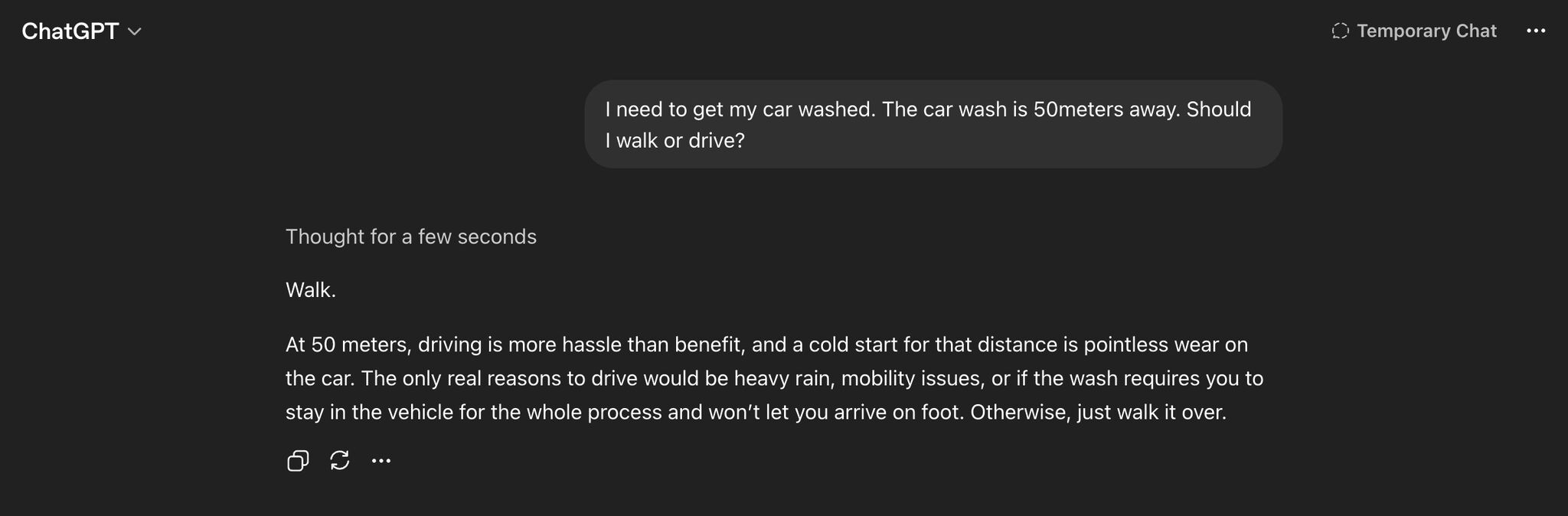
Figure 1.
You can guess that the distance being 50m in the query triggered the "walk" inference.
You don't have to be an AI researcher to guess why.
It's because walking 50m is a decent heuristic in the problems posed in travel-related FAQs, which appear in WRITTEN text that has been swallowed up during pre-training.
One could solve for this specific type of failure by excellent post-training, which is probably true since Claude and Gemini both get this question right, but the point stands about deliberate engineering.
So why should you care? Am I merely pointing out quirky ways in which AI goes wrong? No. GPT5.4 Thinking (Heavy) is a capable model that's probably doing excellent knowledge work right now. What am I exposing in the second screenshot that shows you how to rub the magic lamp to get to the correct answer?
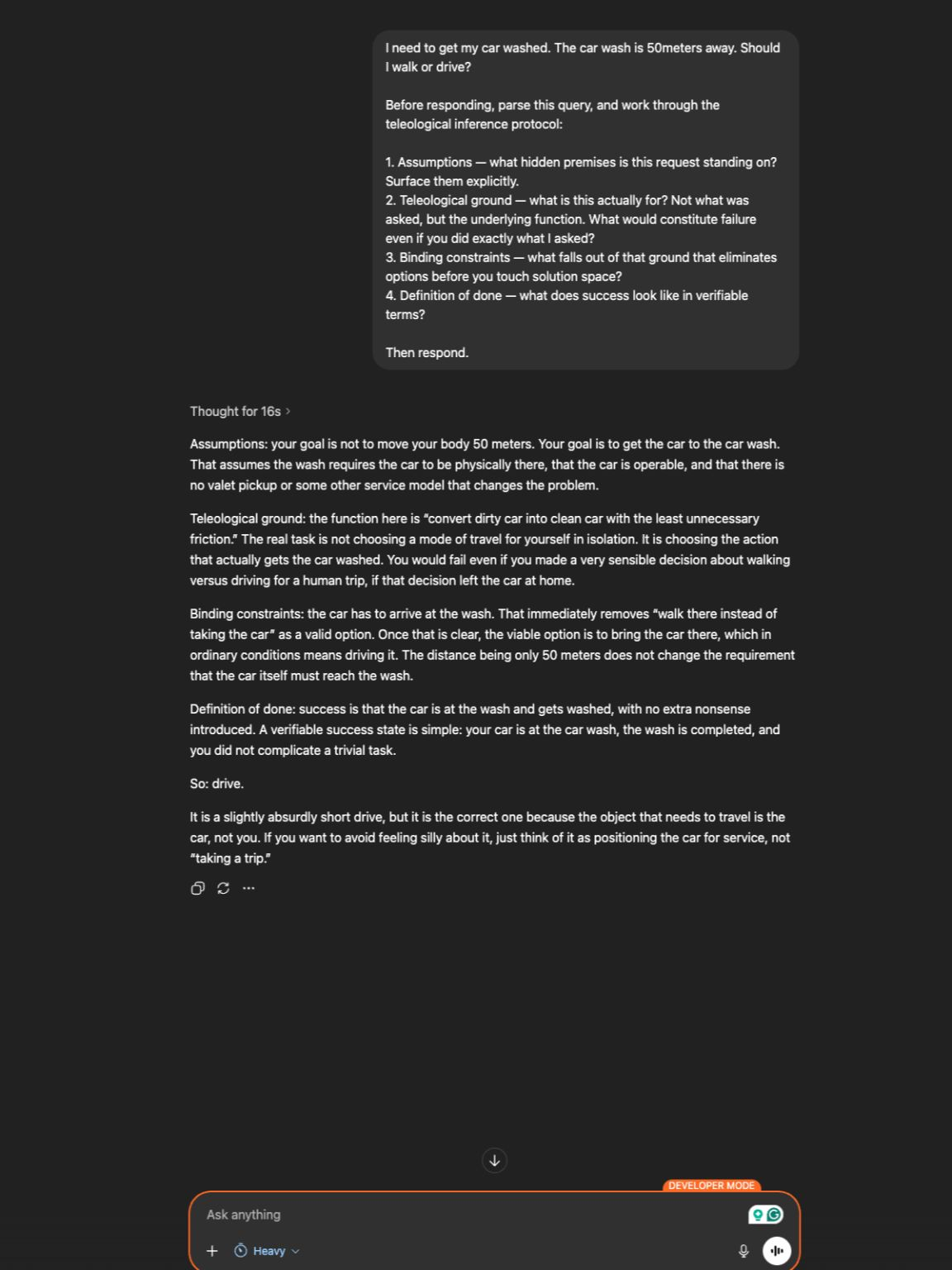
Figure 2.
You see, some things about the world are simply too obvious, way too self-evident to humans, that no one would bother to spell them out in writing. Because no one writes them down as preambles, in a studied philosophical first-principles-thinking treatise laying out how the world "hmm-akshcually" works, i.e., the world model, they don't naturally become part of a training corpus, and consequently, don't become implicit and reflexive during inference.
Prompters recognise this world-model deficit, and explicitly control for it, upfront; the part of the prompt lifecycle where you define intent, goal, and guardrails.
This lesson comes built in, say in Deep-research systems that elicit user clarification after an initial request. Think about the function of this clarification to prevent blow-ups. What are they clarifying exactly? At the highest level, it's the telos:
- what's the goal here?
- the assumptions (constraints)
- the anti-goals, unless a definition of good can be specified upfront through prompting
The tradecraft--amongst other things--is to first refine and elicit the teleological ground at the very start. From this teleological ground, all good knowledge work can proceed without catastrophic failures.
Teleological inference has been the most reusable skill.md in my workflows.